
How AI Identifies Your Celebrity Twin: The Technology Behind Look-Alikes
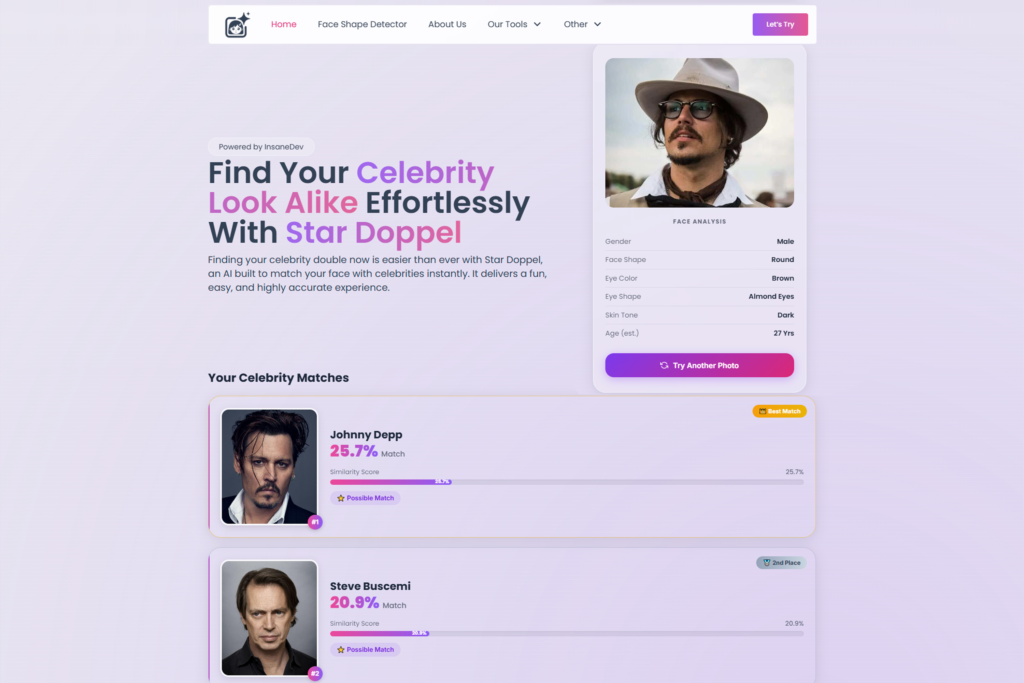
The work of matching a face to a noted twin relies on a intermix of computing machine visual sensation, simple machine scholarship, and boastfully curated databases of famous person images. Modern systems bust down a photo into measurable facial landmarks jawline, cheekbones, eye spacing, nose shape, grin curvature, and overall proportions then understand those features into numeric vectors that can be compared across thousands of faces. This set about allows an AI-powered system of rules to move beyond subjective impressions and make repeatable, data-driven comparisons celebrity look alike ai.
Convolutional neural networks(CNNs) skilled on various face datasets extract distinguishing patterns while method of accounting for variations in expression, slant, and light. After sport , law of similarity metrics such as cos similarity or Euclidean outdistance make how intimately two faces align in the model s feature space. High-scoring matches are presented as potency celebrity look-alikes, often with trust percentages or ranked results to indicate relation stuffiness.
Beyond raw duplicate, some services let in face-attribute depth psychology to foreground why a particular celebrity was chosen for example, a divided oval face shape or a similar eye-to-nose ratio. While these explanations are easy, they help users sympathize that resemblance is a combination of many moderate similarities rather than one commanding trait. Privacy and refuge are also probatory: reputable platforms process images transiently and use procure treatment to assure photos are used only for the conscious . The result is not an recognition tool but a fun, diverting exploration of resemblance driven by advanced seventh cranial nerve realisation techniques.
Ways to Use Your Celebrity Look-Alike: Social Sharing, Events, and Casting
Finding which famous person you resemble most opens a variety of practical and playful uses. For social media users, a look-alike break can become a shareable moment a promptly post, a story update, or a friendly poll among friends to or take exception the AI s pick. Content creators often use famous person results as meat hooks for videos, thumbnails, or participation prompts that tempt following to liken their own twin results.
In topical anaestheti and professional person scenarios, look-alike tools can be surprisingly useful. Event planners in cities from New York to Los Angeles sometimes hire impersonators or entertainers who resemble a pop star; informed the most likely celebrity matches among volunteers makes casting easier. For theatre or themed parties, organizers can oppose participants to celebrities to assign roles or design costumes. Even small businesses such as photo studios and political party vendors use look-alike insights when promoting themed photo booths or sociable campaigns targeting topical anaestheti audiences.
Real-world examples let in a Chicago lensman who used a famous person look-alike analysis to topic a bridal shoot up around hex icons, and a merchandising team that created a city-wide social take exception asking residents to post their celebrity pit for a chance to win tickets to a local event. For unplanned wonder or professional provision, the system s fast, browser-based interface makes it simpleton to try out. Try a demo and partake your lead with friends to see how unobjective impressions line up against an AI-generated match, whether for entertainment or engagement.
Explore an example serve to try your own oppose: .
Tips to Get the Best Match: Photo Quality, Posing, and What to Expect
Quality of stimulation greatly affects the result. To step-up the chances of a meaty play off, take up with a clear, well-lit photograph where the face is unobstructed. Natural dismount or soft soft indoor lighting reduces harsh shadows, and a nonaligned downpla keeps the focalise on facial nerve features. Aim for a send on-facing or slightly angled portrait rather than extreme point side profiles; many twinned algorithms execute best when key landmarks are visual and rough aligned with their training examples.
Remove accessories that wrap up shaping features large sunglasses, hats, or heavily masks can hide indispensable points used for . Hair, make-up, and seventh cranial nerve hair can shape sensed resemblance; if the goal is to find the nighest morphologic oppose, use a photograph that reflects your unremarkable look. Multiple attempts with wide-ranging expressions(neutral, smiling) and tiddler changes in angle often succumb a broader set of possible celebrity matches and can make the process more fun when comparing results.
Manage expectations: resemblance suggested by an algorithm is about law of similarity in measurable traits, not personal identity. Matches are often pixilated and should be tempered as amusement. Some users will find near-perfect matches, while others will see astonishing pairings that play up an unplanned shared out feature. For group or topical anesthetic projects like casting an impersonator for a city event consider track several photos and comparing the top results to pick out who best fits the desired look.
Finally, honor secrecy and go for. If uploading photos of friends or family, find permission first. When using matches for message or world purposes, elucidate that these are AI-generated likeness comparisons meant for amusement rather than factual statements about personal identity. With those simple guidelines, experimenting with celebrity look-alikes becomes a safe, engaging way to research faces, forge, and subjective stigmatization.
Blog